
The 'Make it happen @D3G Campaign' – 'Mih@D3G'

The 'Make it happen @D3G Campaign' (Mih@D3G) was launched in 2026 by D3G and its collaborators to strengthen collective voice, action, and social impact of the D3-chalky teeth movement. Its purpose is to advance D3G's science-informed, prevention-focused, translational mission by growing engagement, partnerships and implementation worldwide. At its heart is an evolving translational framework for MH & chalky teeth, which shifts attention from isolated dental repair to global prevention and social good. With this reconceptualisation of the chalky teeth problem now underway through collaboration with leading lights and major stakeholders across the sector, attention turns to broader uptake and refinement at larger scale. That's what we mean by "make it happen at D3G".
Clearly, D3G can't do this on its own – nor should it. Collaboration and partnership are already embedded in the D3-chalky teeth movement – so further collective effort and joint venture are warranted, ultimately involving the whole sector worldwide. The Campaign therefore invites all interested parties to 'Join the Club D3'.
Our "Mih Campaign" also carries a cheeky second meaning. We're particularly keen to help modernise the legacy concept "MIH" in ways
that retain clinical utility while better engaging contemporary science
, prevention and translation to social good. This evolutionary upgrade
doesn't discount knowledge developed during the MIH era – it simply
builds on it for the betterment of all.
Why translational implementation matters
In the progressive "science to social good" sense, science translation involves many stages – often these start with a scientific discovery, followed by various steps of development through to product or policy, then implementation and uptake at society level. Many other starting points exist – such as the need to modernise traditional concepts – leaving implementation as the key common factor for achieving social good. We refer to stakeholders involved in this last stage as "end translators" because they help bring translated knowledge into real-world use. In our case, these implementation partners include professional organisations, industry, policymakers, governments, social impact backers and the public. All are encouraged to join this campaign.
The 'Mih@D3G Projects'
To help get the "implementation ball" rolling, we invite constructive participation, from all quarters, in the following projects (contact us).
PROJECT 1: Universal standards for D3 reporting
A big problem surrounds today's lack of standardised reporting across the D3-chalky teeth domain. Readers of today's literature for MIH and other D3s – be it in academic, professional, industry, or media settings – face a terminological chaos that is damaging at multiple levels and ultimately erodes the social impact of D3 science. D3G is attacking this problem in multiple ways, including: (1) providing exemplars across academic and general contexts; (2) event-based education and advocacy; and (3) developing draft guidelines to foster engagement and consensus.
- Action 1: D3 Reporting Guidelines – see here
PROJECT 2: Translational Peer Review initiative
One massive advantage of a translational science approach is ready access to various stakeholders from across the sector. And when it comes to highest-quality reporting – particularly in academic contexts – peer review at translational level empowers the "conversion of science into social good" in ways unavailable to traditional peer reviewing (i.e. discipline-based). This academically grounded initiative seeks to complement Project 1 by developing a translational peer review service that ultimately will be accessible to users from across the sector.
- Action 1: Translational Peer Initiative – see here
PROJECT 3: Modernising MIH for social good
In a nutshell, we think it fair to say that "heel dragging" over modernisation of a 25-year-old clinical concept is undermining new opportunities for social good. Today, MIH remains a commonly used clinical term – warts and all – deeply embedded in teaching, clinical practice and the literature. However, after years of increasingly vocal concern, D3G's participation at two international events in 2025 (Enamel 11, IAPD Cape Town) finally evoked a resounding call for action over the MIH community's apparent reluctance to "get with the translational times", terminologically and conceptually speaking. Concerns centred on the ongoing stream of "MIH" academic publications and conference presentations that failed to at least acknowledge the well-established scientific transition from traditional "MIH" to D3-era thinking – despite high-level adoption of the new translational paradigm in other quarters. Conversely, we also heard about pushback (aka "change resistance") faced by some MIH-oriented colleagues modernisation. When "MIH loyalists" explained their reluctance to change, the collective reasons for retaining MIH terminology lacked scientific or translational strength. At the Enamel 11 mini-symposium – a deliberately MIH-free setting using D3 terminology, D3-lingo setting – many participants commented on how readily they made the switch. Given that these circumstances are two sides of the same coin – continued reliance on clinical tradition on one hand, and advancement of science translation to social good on the other – we've dubbed it the "MIH modernisation dilemma". Read more about the delightful mechanics of paradigm shifting here.
Building from Projects 1 and 2, the publishing ecosystem (comprising writers, reviewers, editors, publishers, bibliographic services, and critical readers) was chosen as a sensible starting point for ameliorative actions, with Letters to the Editor an initial focus. Targeted events – designed to provide a comfortable open-discussion environment for MIH-oriented colleagues and others who may have missed D3G's earlier offerings – were identified as a complementary second approach.
- Action 1: Letters To The Editor Initiative – see below
- Action 2: 'Modernising MIH' events – IADR-Melbourne 2027, symposium proposal pending
Letters To The Editor Initiative
As noted above, from a translational standpoint at least, it's problematic that many journals continue to publish articles that not only remain rooted in the traditional clinical concept of MIH, but also do not adequately engage with today's translational science advances. Immediate impacts on clinical practice are perhaps moot, but such "journalistic imbalance" arguably undermines the pursuit of "best quality evidence". If authors, reviewers and editors are seen as having shared responsibility for best-practice reporting, a letter to the editor offers an efficient way to address all three parties simultaneously, while fostering future engagement with the journal.
Our Letter writing initiative seeks to enrich various MIH articles we regard as particularly impactful – first, by highlighting their positive elements, and second by adding our complementary translational perspective. In other words, it's a constructive "go from strength to strength" strategy, offered as an invitation to "jump onto the D3 translational wave".
- Action 1: Letter to the editor at European Archives of Paediatric Dentistry – see below
- Action 2: Letter to second journal – underway
- Action 3: Letter to third journal – underway
- Action 4: Letter to fourth journal – pending
Letter to the Editor, European Archives of Paediatric Dentistry
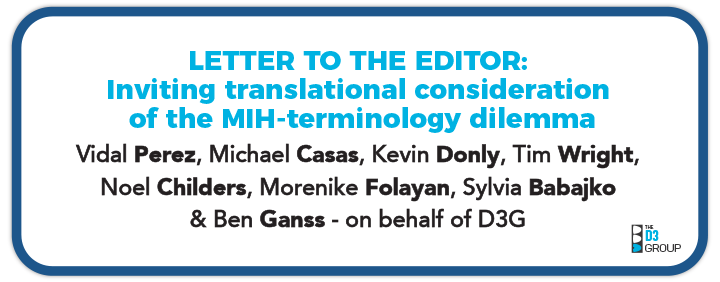
Responding to a scoping review article about updating clinical terminology from the "MIH era" – which, without reference to the D3-chalky teeth movement, concluded "it may be timely to reconsider the terminology currently in use and adopt a more inclusive one" – eight D3 leaders submitted a Letter on behalf of D3G that: (1) applauded this conclusion; (2) encouraged broader consideration beyond a solely clinical viewpoint; and (3) invited cross-sector participation in a move towards universal adoption of the socially transformative paradigm for MH and chalky teeth. It also cited a key publication that was not included in the scoping review.
Cross-sector contributions to, and support for, our Letter
To "practice what we preach", the Letter's authorship comprised two career scientists, five paediatric dentists – all researchers with academic roles, and two of whom serve as chief editors of leading dental journals – and a global health expert (also a paediatric dentist). Before submission, the Letter was internally peer reviewed by a further two career scientists, an oral health therapist, two paediatric dentist/researchers, an orthodontist, a public health dentist, two medico-dental experts, an industry representative, and a publicised MH-affected family.
Unfortunately, the Letter was not accepted for publication. The revised manuscript has therefore been made available as an open Commentary, inviting constructive scholarly discussion of the issues raised.
Download the resubmitted manuscript, revised in response to the single reviewer report received.
Download the ensuing Commentary, available as a preprint.
Read the EAPD article by Bandeira Lopes et al, 2026.
SIGN ON AND HAVE YOUR SAY ABOUT 'Mih@D3G'
| SIGN ON - HAVE YOUR SAY |
Since D3G's inception, we've been consolidating facts, ideals and opinions to develop our distinctive translational take on what will do most good for the world. We now invite your views on this Campaign to advance D3G's science-informed, prevention-focused, translational mission. Constructive comments – both supportive and critical – are welcome from all backgrounds and perspectives. Feel free to address the Campaign as a whole, or specifics under Projects 1-3.
You can either:
(1) sign on in support – it takes just a couple of clicks – with the option to provide feedback; or
(2) provide constructive feedback without signing on.
Note: Feedback-only responses do not indicate endorsement. D3G will receive submitter details in confidence, but public acknowledgement under "Feedback received" is optional.
Signed-on supporters' standpoint:
We realise that many readers will have "grown up in the MIH era", so to speak. A rapidly growing number of us have since evolved to embrace the "D3 era" – guided by D3 science, prioritising prevention, and pursuing social good while retaining the hard-won benefits of earlier times. D3G's cross-sector, global experience shows what becomes possible when diverse expertise and interests are brought together together – see recent examples here. We welcome others to bring their expertise, make the switch, and Join The Club D3.
Ideas for feedback:
- What do you think about our commentary on the EAPD article, and the "MIH modernisation dilemma" more generally?
- What scientific, clinical, educational or implementation reasons support retaining the MIH concept? Could these facets instead be accommodated within the translational approach?
- What concerns, if any, do you have about D3G's evolving approach to science-informed development of the field?
- Do you support the ideals behind Mih@D3G? If not, what alternative direction would you propose?
- Are you happy that "Make it happen" (Mih) has given "MIH" a new lease of life built around translational science?
- Does the Campaign provide clarity about D3-era thinking and the translational paradigm? If not, what information or discussion would help?
Feedback received
| "As a pediatric dentist and clinician, I support the idea of changing terminology to MH, this term being more inclusive of the "spectrum" we find clinically in so many children and avoiding confusing parents." |
| "I still have my doubts about MH excluding (by definition) primary incisors which I believe is very important in the "spectrum" of hypomineralisation and key risk factor for ECC." [Editor: primary incisors ARE included subject to idiopathic, systemic causation and at least one HM-molar. Otherwise use HM-incisor instead of MH. See here] |
| "As an Oral Health Therapist practicing predominantly within School Dental Services, I endorse adoption of the term MH. I'm committed to advancing clinician, parent, and patient education to improve early recognition and understanding of MH and its clinical implications." |
Signed-on Supporters of 'Mih@D3G'
| CAREER SCIENTISTS | ||
| Ben Ganss | Toronto, Canada | Letter author |
| Sylvie Babajko | Paris, France | Letter author |
| Mike Hubbard | Melbourne, Australia | Internal reviewer |
| Felicitas Bidlack | Boston, USA | Internal reviewer |
| ORAL HEALTH PROFESSIONALS | ||
| Julie Barker | Hobart, Australia | Internal reviewer |
| Kate Churchill | Queensland, Australia | D3G member |
| PAEDIATRIC DENTISTS | ||
| Vidal Perez | Talca, Chile | Letter author |
| Mike Casas | Toronto, Canada | Letter author |
| Kevin Donly | Galveston, USA | Letter author |
| Noel Childers | Birmingham, USA | Letter author |
| Tim Wright | Chapel Hill, USA | Letter author |
| Katia Jedeon | Paris, France | Internal reviewer |
| Rami Farah | Amman, Jordan | Internal reviewer |
| Camila Palma | Lima, Peru | D3G member |
| ORTHODONTISTS | ||
| Norman Nagel | Los Angeles, USA | Internal reviewer |
| PUBLIC HEALTH DENTISTS | ||
| Robert Schroth | Winnipeg, Canada | Internal reviewer |
| MEDICO-DENTAL PROFESSIONALS | ||
| Janet Southerland | New Orleans, USA | Internal reviewer |
| Ophir Klein | Los Angeles, USA | Internal reviewer |
| GLOBAL HEALTH PROFESSIONALS | ||
| Morenike Folayan | Ile-Ife, Nigeria | Letter author |
| INDUSTRY | ||
| Stephen Haynes | Sydney, Australia | Internal reviewer |
| PUBLIC LIVED EXPERIENCE | ||
| Ditcham family [National TV] | Melbourne, Australia | Internal reviewer |